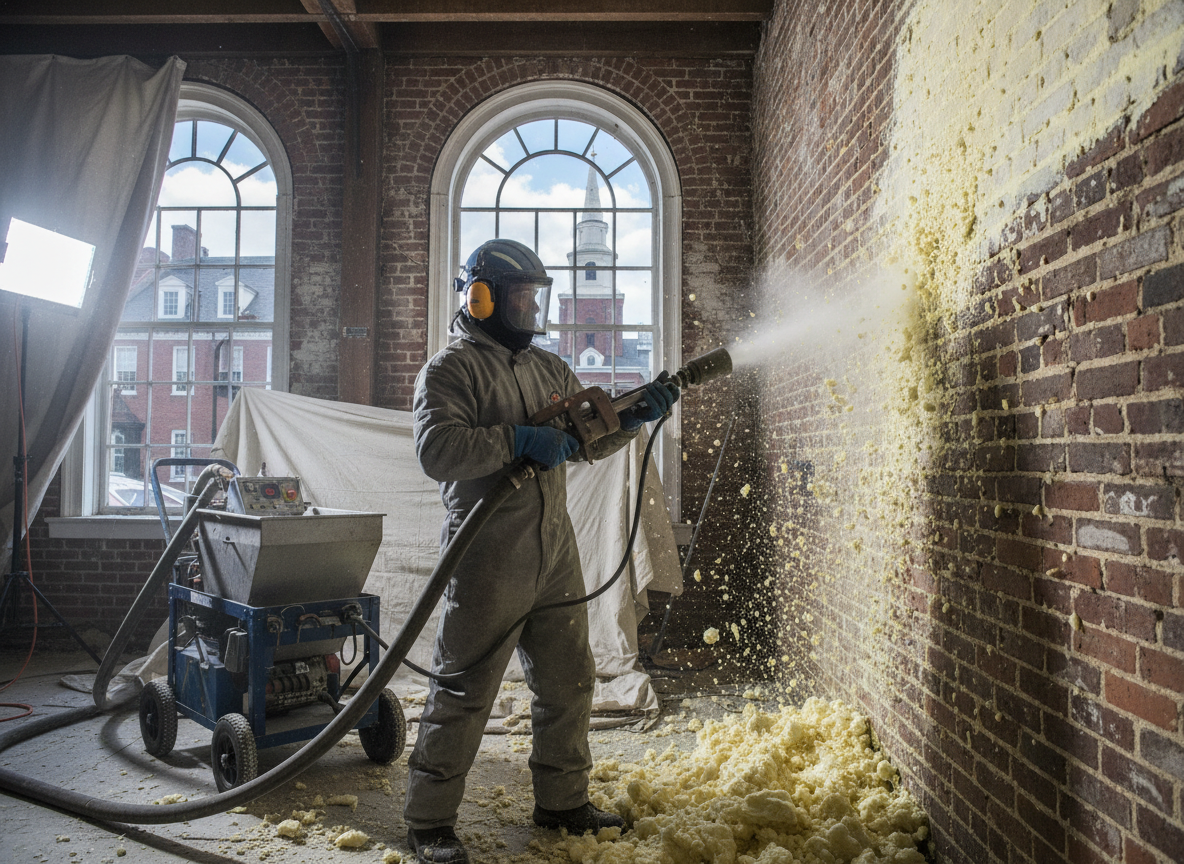
Dry ice blasting uses solid CO2 pellets accelerated at high velocity to fracture and lift spray foam insulation from timber joists, brickwork and plaster without scraping or chemicals. In Boston the method suits Victorian terraces around Market Place and post-war semis in the Skirbeck quarter where foam was often applied directly to uneven lath and plaster or exposed rafters. The pellets sublimate on impact so there is no secondary waste stream to manage inside tight roof voids common in Lincolnshire fen properties. Operators must monitor substrate temperature because older lime mortar joints can spall if the surface drops too quickly during winter callouts.
Edge cases arise when foam has been over-sprayed into electrical chases or around chimney breasts in Boston's terraced stock. Dry ice avoids the vibration risk of mechanical scraping that can dislodge loose brickwork in 19th-century gables. Moisture trapped behind closed-cell foam is a frequent discovery once removal begins; the process reveals damp patches on north-facing walls that face the prevailing winds off the Wash. Proper extraction and ventilation during blasting prevents re-condensation inside the roof space, especially when temperatures remain below 8 °C for days as they often do from November through February.
Regulation requires notification to the local authority when disturbing insulation that may contain legacy materials, though dry ice itself produces no residue that triggers additional waste licensing. Homeowners in the Boston area frequently request this method after failed attempts with handheld scrapers that leave foam residue in the grain of rafters, creating future adhesion points. The technique also preserves the original breathability of solid-wall construction that dominates the town centre, reducing the chance of interstitial condensation once new insulation is installed.
Technician insight
In Boston, the thing that catches most people out with dry ice blasting spray foam removal is the amount of hidden damp behind foam in 1930s semis along London Road; once the pellets clear the insulation you often find the original felt underlay has failed and water has been sitting against the brick for years.
Skirbeck Terrace Loft
Foam in a 1920s terrace had trapped condensation against the rafters. Inspection showed saturated timber near the chimney. Dry ice blasting cleared the foam cleanly without disturbing the brickwork. New breathable insulation was installed after drying.
How it works
- 1
Site Assessment
Inspect loft or wall cavities, note substrate condition and any electrical or plumbing runs in Boston properties.
- 2
Containment Setup
Seal access points and install dust extraction to protect living spaces below.
- 3
Dry Ice Blasting
Apply CO2 pellets at controlled pressure to lift foam while monitoring surface temperatures.
- 4
Debris Removal and Final Check
Vacuum residues, inspect for hidden damp or damage, and confirm substrate is clean for re-insulation.
Pricing
Cost depends on foam thickness, access difficulty and property age; upfront quotes provided after inspection.